
Infectious Smile maps: Stage Layouts, Hazards, and Key Spawns
Infectious Smile maps generate dynamically in rows between spawn and the safe fortress every five minutes after a disaster clears. Over sixty distinct stages feature unique hazard layouts, weapon spawns, puzzle switches, and color-coded key routes for humans and infected runners.
Infectious Smile maps generate dynamically in rows between spawn and the safe fortress every five minutes after a disaster clears. Over sixty distinct stages feature unique hazard layouts, weapon spawns, puzzle switches, and color-coded key routes for humans and infected runners.
Stage Rotation and Generation Mechanics
Every round in Infectious Smile relies on an active environmental cycle. The seismic activity gauge fills over a five-minute window, triggering a map-wide disaster such as an earthquake, flood, rising lava, or blizzard. Players must retreat to the starting point, the side street, or the fortress safe zone to survive the collapse. Once the disaster subsides, the game clears the playing field and generates two to four stages in a continuous line.
Standard stages occupy a single structural slot, while larger stages span two full slots. When double-length maps such as Desolate Shelter, Old Labway, or Refrigerator Hallway load into the rotation, fewer total stages can spawn between the human camp and the base. Server VIPs who own the Choose Next Map gamepass can force specific stage selections once every 60 minutes using chat commands, which heavily alters map frequency on populated servers.
The fortress at the far end of the course features a gate shield operated from an interior control button. When humans hold the structure, shelter doors keep survivors alive during mountain disasters. If infected players control the fortress for an extended period, red banners appear, the orange forcefield drops, and the structure converts into a Smile base with external weapon spawns.
Supply Distribution and High-Value Stages
Certain stages house fixed arsenals, locked safes, and key doors that grant team-wide advantages. Exploring these rooms requires solving environmental tasks or timing runs past active hazards.
Lockers stands as one of the most populated stages due to its multi-tier layout and concentrated loot. The ground area houses a dark gray cabinet that dispenses up to ten shotguns on a first-come basis. The second and third floors hold green key doors concealing giant potions and the tommy gun. Players carrying a red key can unlock a green key, while a rusty locker occasionally appears on the map to supply a white key.
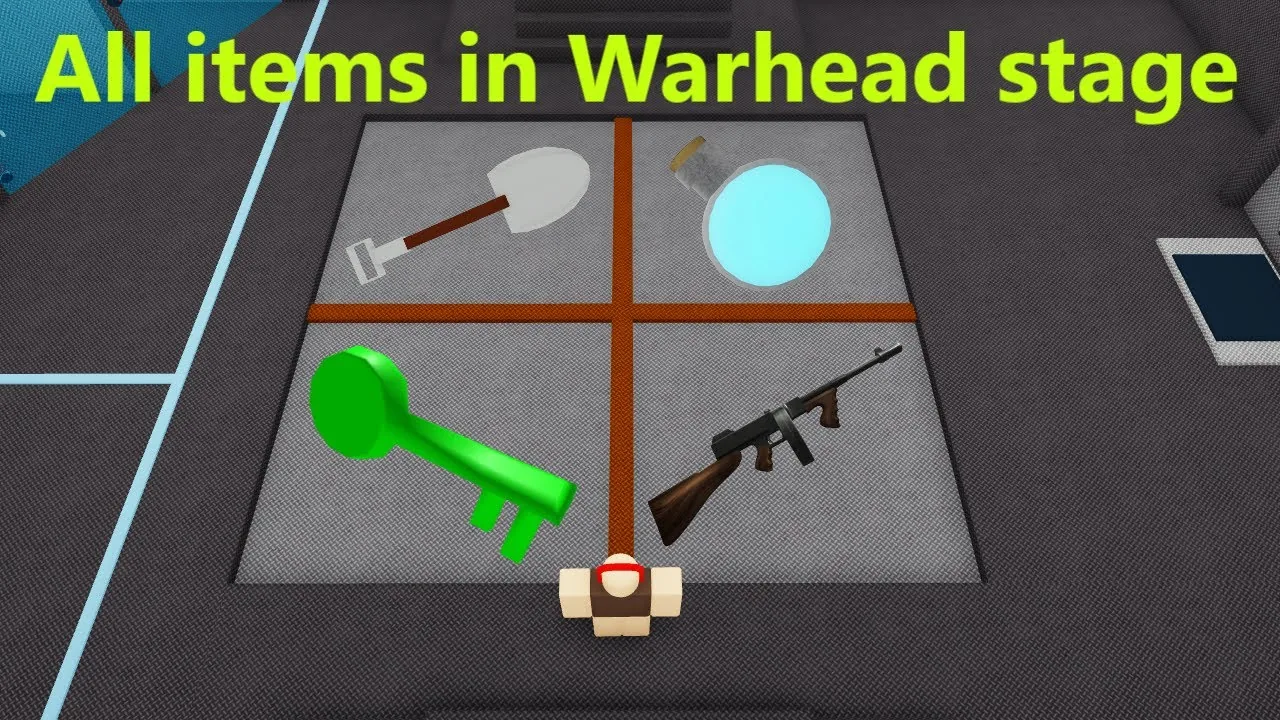
Warhead presents an interactive objective centered around an unexploded missile. A human survivor must hold the position for 60 seconds against waves of enemy NPCs before pressing the green activation switch. Detonating the warhead collapses the structure into rubble, revealing a subterranean ruin filled with items. The destroyed map contains scattered firearms, a shovel, a white key, and an underground hatch that opens during disasters to reveal a green key and additional heavy weapons.
Gun Factories exists in two distinct variants: Gun Factory and Gun Facility. Both variants require players to activate a button with a two-second cooldown, dispensing ten orange cylindrical batteries along a conveyor into a receiver. Filling the progress bar unlocks a central glass case containing three handguns, which automatically locks and resets after 45 seconds.
Shotgun Access challenges players to sprint through an industrial corridor bisected by lethal security lasers. A side control console allows occupants to slide beams vertically or horizontally across the hallway. Survivors who reach the opposite ladder can climb over the partition into the armory to claim a wall-mounted firearm and escape through an exterior breach.
Tracking key locations across intermediate rooms remains necessary for opening locked gates. Stages such as Ball Ramp, Dead Forest, Exhaust Room, and Vents contain fixed or corner spawns for white keys, while Sawblades, Corridor, and Prison allow survivors to trade white keys for red keys.
Tactical Selection Across Active Stages
Every stage requires distinct positioning to balance speed, combat readiness, and environmental awareness.
| Stage Name | Tactical Advantage | Danger or Hazard |
|---|---|---|
| Lockers | Dispenses up to 10 shotguns and holds rooms for top-tier weapons | Crowded doors allow ambushes and competitive key theft |
| Desolate Shelter | Spawns multiple firearms and keys across two underground sectors | Active lava obby and narrow spiral corridors |
| Gun Factories | Produces three handguns after processing ten battery cylinders | Conveyor drop-offs and open pits into the void |
| Shotgun Access | Supplies a direct firearm pickup from the weapon rack | Console-activated hallway lasers operated by other players |
| Steel Bridges | Yields an iron potion along lower scaffolding | Narrow beams with empty drops into the void |
Desolate Shelter features two distinct zones separated by an underground obstacle course. The upper entrance leads into a multi-tiered bunker containing a pistol, shotgun, axe, and speed potion. Crossing the lava obstacle course in the second sector leads to a red key spawn, while an adjacent spiral maze yields a white key.
Steel Bridges suspends elevated walkways above the void in a cross formation. Players can toggle entry gates from a wall switch, but acquiring the iron potion requires dropping down to walk across the narrow metal girders beneath the floor.
Game Mode Variants and Special Terrain Rules
Stage availability and layout behavior shift depending on server settings and selected game types.
In elimination mode, certain defensive zones are disabled to keep rounds fast. Cinder Canyon appears exclusively in elimination mode, challenging players with split roads running alongside yellow lava pools. Refrigerator Hallway was shifted into an elimination-exclusive stage following update adjustments, requiring players to clear two connected zones while managing a freezing mechanic that slows movement over time. The Boxing Ring stage was removed from elimination mode entirely to avoid stalled 1v1 engagements.
Unusual terrain rules govern specific specialized maps. In the swamp of sadness, deep water periodically rises and drains across the floor. When an infected player steps into the water, their character loses the smile transformation and reverts into a sad-faced human. Because of this conversion mechanic, Swamp of Sadness cannot be selected with the VIP stage command and never enters the elimination mode map pool.
Seasonal events periodically introduce temporary maps that leave the active pool after major patches. Limited-time event stages and earlier releases form the list of removed maps, including Ghost Town from the 2025 Halloween update, Flood Cistern, and PM 6:06. Permanent stages continue to rotate after every five-minute seismic collapse, requiring players to adjust their movement routes each round.